😮 Rejoignez nos [ 6.000 abonnés ]
Comment réduire sa facture d'énergie ? [ gratuit ]
jeudi, juillet 30, 2026
  • Connexion
Enerzine.com
  • Accueil
  • Energie
    • Electricité
    • Marché Energie
    • Nucléaire
    • Pétrole
    • Gaz
    • Charbon
  • Renouvelable
    • Biogaz
    • Biomasse
    • Eolien
    • Géothermie
    • Hydro
    • Hydrogène
    • Solaire
  • Technologie
    • Batterie
    • Intelligence artificielle
    • Matériaux
    • Quantique
    • Recherche
    • Robotique
    • Autres
      • Chaleur
      • Communication
      • Fusion
      • Graphène
      • Impression
      • Industrie énergie
      • Industrie technologie
      • Laser
      • Nanotechnologie
      • Optique
  • Environnement
    • Carbone
    • Circulaire
    • Climat
    • Déchets
    • Durable
    • Risques
    • Santé
  • Mobilité
    • Aérien
    • Infrastructure
    • Logistique
    • Maritime
    • Spatial
    • Terrestre
  • Habitat
  • Insolite
  • GuideElectro
    • Sommaire
    • Maison
    • Chauffage
    • Bricolage
    • Jardin
    • Domotique
    • Autres
      • Isolations
      • Eclairage
      • Nomade
      • Loisir
      • Compostage
      • Médical
  • LaboFUN
    • Science
    • Lévitation
    • Globe
Aucun résultat
Voir tous les résultats
  • Accueil
  • Energie
    • Electricité
    • Marché Energie
    • Nucléaire
    • Pétrole
    • Gaz
    • Charbon
  • Renouvelable
    • Biogaz
    • Biomasse
    • Eolien
    • Géothermie
    • Hydro
    • Hydrogène
    • Solaire
  • Technologie
    • Batterie
    • Intelligence artificielle
    • Matériaux
    • Quantique
    • Recherche
    • Robotique
    • Autres
      • Chaleur
      • Communication
      • Fusion
      • Graphène
      • Impression
      • Industrie énergie
      • Industrie technologie
      • Laser
      • Nanotechnologie
      • Optique
  • Environnement
    • Carbone
    • Circulaire
    • Climat
    • Déchets
    • Durable
    • Risques
    • Santé
  • Mobilité
    • Aérien
    • Infrastructure
    • Logistique
    • Maritime
    • Spatial
    • Terrestre
  • Habitat
  • Insolite
  • GuideElectro
    • Sommaire
    • Maison
    • Chauffage
    • Bricolage
    • Jardin
    • Domotique
    • Autres
      • Isolations
      • Eclairage
      • Nomade
      • Loisir
      • Compostage
      • Médical
  • LaboFUN
    • Science
    • Lévitation
    • Globe
Aucun résultat
Voir tous les résultats
Enerzine.com
Aucun résultat
Voir tous les résultats
Des nanoparticules d'argent au cœur des progrès des batteries solides

Des nanoparticules d’argent au cœur des progrès des batteries solides

par La rédaction
5 mars 2025
en Batterie, Technologie

Alors que la demande croissante pour des appareils électroniques à haute autonomie et des véhicules électriques aux performances accrues se heurte aux limites des batteries lithium-ion actuelles, une nouvelle génération de dispositifs énergétiques suscite un intérêt marqué dans les cercles scientifiques. L’accent est désormais mis sur des technologies capables de repousser les contraintes énergétiques tout en répondant aux exigences environnementales contemporaines.

Une équipe dirigée par Kelsey Hatzell, professeure associée en génie mécanique et aérospatial ainsi qu’au sein du Centre Andlinger pour l’énergie et l’environnement, a exploré des pistes permettant d’améliorer les performances des batteries sans anode à électrolyte solide. Leurs travaux ont permis de lever un voile sur des mécanismes fondamentaux susceptibles de surpasser les capacités des batteries lithium-ion traditionnelles. « Si ces batteries peuvent être introduites avec succès, il sera possible d’accéder à des densités énergétiques impossibles avec les batteries conventionnelles« , a t-elle affirmé.

Dans une batterie classique, deux électrodes – une cathode positive et une anode négative – sont séparées par un électrolyte liquide. Les ions circulent entre ces composants pour produire de l’énergie. Toutefois, les dispositifs étudiés par Kelsey Hatzell remplacent cet électrolyte liquide par un matériau solide. Ce changement modifie substantiellement les propriétés physiques et chimiques du système. Par ailleurs, l’absence d’anode réduit encore davantage les coûts de fabrication tout en augmenté la compacité des dispositifs.

Contact imparfait : un obstacle technique complexe

Malgré leurs avantages potentiels, ces batteries présentent des défis techniques notables. Parmi eux figure le maintien d’un contact optimal entre l’électrolyte solide et le collecteur de courant. Une étude publiée dans ACS Energy Letters par Se Hwan Park, chercheur postdoctoral au sein du groupe de Hatzell, a examiné l’influence de la pression appliquée sur ce contact critique. « Au cours de la charge et de la décharge, la batterie subit une réaction électrochimique. En appliquant une pression externe, des forces mécaniques sont également introduites« , explique t-il. Cette interaction complexe souligne la difficulté de garantir un dépôt uniforme des ions.

Des pressions faibles entraînent un contact irrégulier, provoquant des zones de surchauffe et des vides qui fragilisent l’électrolyte. À l’inverse, des pressions élevées amplifient les imperfections présentes à la surface des matériaux, engendrant des fractures sous l’effet des contraintes mécaniques. De telles observations ont conduit Kelsey Hatzell à souligner que « résoudre cette problématique de contact constitue une étape indispensable« .

Couches intermédiaires : une solution innovante

Pour pallier ces difficultés, une autre recherche menée par l’équipe a porté sur l’utilisation de couches intermédiaires, appelées intercouches, placées entre l’électrolyte et le collecteur de courant. Publiée le 19 décembre dans Advanced Energy Materials, cette étude a révélé que des particules de carbone et d’argent nanométriques facilitent un dépôt métallique plus homogène. Les résultats obtenus montrent que la taille des nanoparticules d’argent influence directement la stabilité du système.

Les particules de 200 nanomètres créent des structures filiformes instables, tandis que celles de 50 nanomètres favorisent des configurations plus denses et uniformes. « La morphologie du métal lors du dépôt et du retrait est liée à la stabilité du système« , a dit Se Hwan Park. Ces découvertes guideront probablement les stratégies futures de conception industrielle.

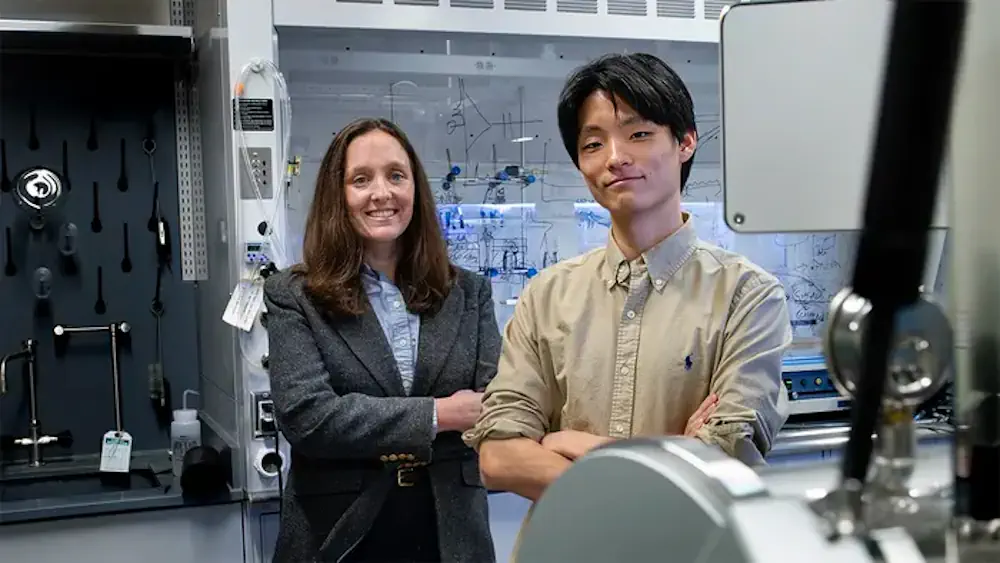
Le professeur Kelsey Hatzell et le chercheur postdoctoral Se Hwan Park dans le laboratoire de Hatzell
Le professeur Kelsey Hatzell et le chercheur postdoctoral Se Hwan Park dans le laboratoire de Hatzell. (Photo de Bumper DeJesus)

Passage à l’échelle industrielle : un horizon proche ?

Un article publié le 2 janvier dans Nature Materials par Kelsey Hatzell et ses collaborateurs du projet MUSIC a synthétisé les progrès réalisés dans ce domaine. La transition des laboratoires vers des chaînes de production commerciales demeure un objectif central.

Des entreprises comme Samsung et Toyota ont annoncé des calendriers ambitieux pour la production de masse d’ici à 2030. Kelsey Hatzell a exprimé son optimisme quant à la capacité des recherches actuelles à soutenir ce déploiement : « Le travail effectué aujourd’hui au sein de MUSIC pourrait servir de fondation au développement de ces batteries à grande échelle« .

L’intégration de ces innovations dans les processus manufacturiers existants reste cependant un défi majeur. Les efforts concertés des chercheurs visent à rendre ces dispositifs non seulement performants mais également viables économiquement.

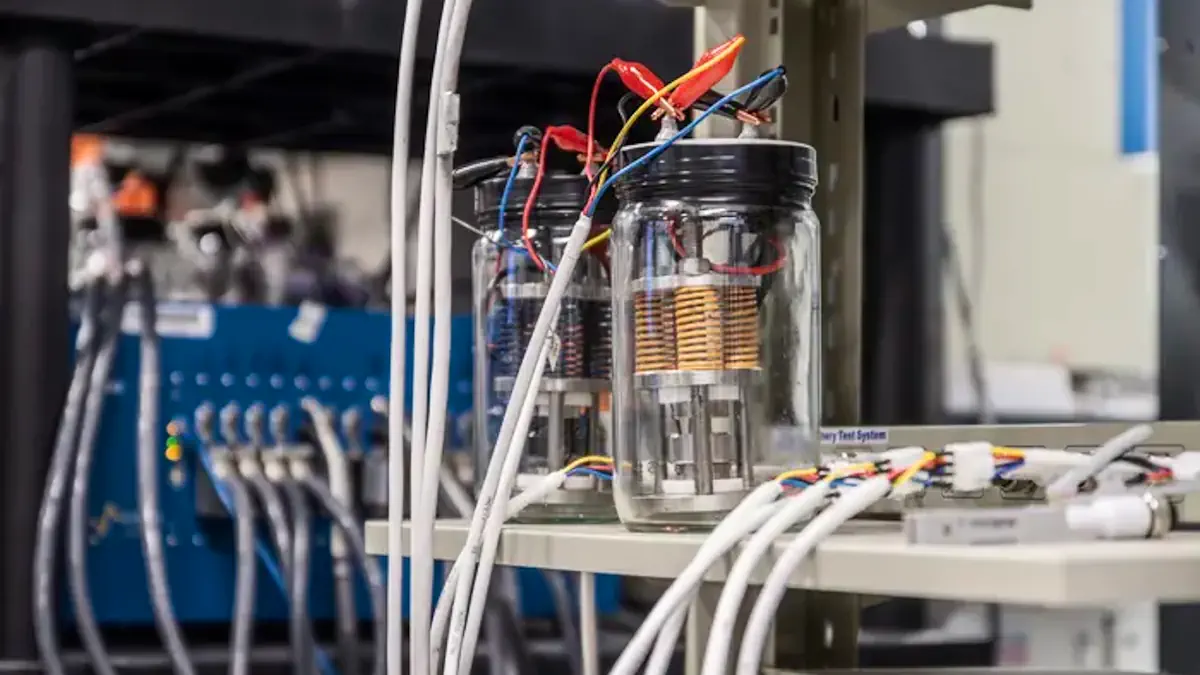
Légende illustration : Un dispositif construit pour mesurer les effets de la pression sur un système de batterie. (Photo de Bumper DeJesus). Crédit : Bumper DeJesus, Centre Andlinger pour l’énergie et l’environnement

Article : « Filament-Induced Failure in Lithium-Reservoir-Free Solid-State Batteries » – DOI : 10.1021/acsenergylett.5c00004

Partager l'article avec :
  WhatsApp   LinkedIn   Facebook   Telegram   Email
Tags: batteriesenergielithium-ionsolide
Article précédent

Une nouvelle recherche pourrait révolutionner la détection des blocages d’hydrates dans les pipelines sous-marins

Article suivant

La méthode de production du graphène offre une alternative écologique à l’exploitation minière

La rédaction

La rédaction

Enerzine.com propose une couverture approfondie des innovations technologiques et scientifiques, avec un accent particulier sur : - Les énergies renouvelables et le stockage énergétique - Les avancées en matière de mobilité et transport - Les découvertes scientifiques environnementales - Les innovations technologiques - Les solutions pour l'habitat Les articles sont rédigés avec un souci du détail technique tout en restant accessibles, couvrant aussi bien l'actualité immédiate que des analyses. La ligne éditoriale se concentre particulièrement sur les innovations et les avancées technologiques qui façonnent notre futur énergétique et environnemental, avec une attention particulière portée aux solutions durables et aux développements scientifiques majeurs.

A lire également

Le premier moteur thermique quantique supraconducteur au monde ouvre la voie à des ordinateurs quantiques plus grands
Quantique

Le premier moteur thermique quantique supraconducteur au monde pour des ordinateurs quantiques plus grands

il y a 5 heures
Les batteries perdent du lithium dans le collecteur de courant
Batterie

Les batteries perdent du lithium dans le collecteur de courant

il y a 10 heures
IA générative : l'ADEME alerte sur une empreinte environnementale qui s'emballe
Intelligence artificielle

IA générative : l’ADEME alerte sur une empreinte environnementale qui s’emballe

il y a 1 jour
Une cape thermique 3D rend les objets invisibles à la chaleur dans toutes les directions
Chaleur

Une cape thermique 3D rend les objets invisibles à la chaleur dans toutes les directions

il y a 1 jour
Un polymère élastique imprimable en 3D se révèle étonnamment résistant
Impression

Un polymère élastique imprimable en 3D se révèle étonnamment résistant

il y a 1 jour
Des chercheurs inversent le sens des « arroseurs fantaisistes » pour percer un vieux mystère
Recherche

Des chercheurs inversent le sens des « arroseurs fantaisistes » pour percer un vieux mystère

il y a 1 jour
BYD et Covestro : les polymères au cœur de la stratégie électrique
Matériaux

BYD et Covestro : les polymères au cœur de la stratégie électrique

il y a 2 jours
Une nouvelle technique éclaire de vieux débats sur les matériaux ferroélectriques
Recherche

Une nouvelle technique éclaire de vieux débats sur les matériaux ferroélectriques

il y a 2 jours
Plus d'articles
Article suivant
La méthode de production du graphène offre une alternative écologique à l'exploitation minière

La méthode de production du graphène offre une alternative écologique à l'exploitation minière

La promesse d'un fer, d'un acier et d'un ammoniac verts maintient le rêve de l'hydrogène vert en vie

La promesse d'un fer, d'un acier et d'un ammoniac verts maintient le rêve de l'hydrogène vert en vie

Les robots apprennent à se déplacer en s'observant

Les robots apprennent à se déplacer en s'observant

Laisser un commentaire Annuler la réponse

Votre adresse e-mail ne sera pas publiée. Les champs obligatoires sont indiqués avec *

Newsletter

Recevez les derniers articles dans votre messagerie 📩

Veuillez confirmer votre abonnement !
Certains champs sont manquants ou incorrects !

Vous avez aimé

  • La climatisation : un bouclier contre les particules de fumée des incendies de forêt

    La climatisation : un bouclier contre les particules de fumée des incendies de forêt

    22 partages
    Partage 9 Tweet 6
  • E.Leclerc double ses offres bas carbone avant le chassé-croisé estival

    11 partages
    Partage 4 Tweet 3
  • XPENG dévoile le L03, SUV coupé électrique dopé à l’intelligence artificielle

    10 partages
    Partage 4 Tweet 3
  • Nouveaux billets en euros : la BCE dévoile deux visions de l’Europe et consulte les citoyens

    9 partages
    Partage 4 Tweet 2
  • Des drones chinois anti-incendie, un dispositif innovant face aux départs de feu

    8 partages
    Partage 3 Tweet 2

Tendance

Mercedes-Benz renouvelle son GLA, entre offensive électrique et habitacle piloté par l’IA
Terrestre

Mercedes-Benz renouvelle son GLA, entre offensive électrique et habitacle piloté par l’IA

par La rédaction
30 juillet 2026
0

Mercedes-Benz ouvre un nouveau chapitre pour son SUV compact GLA, dont la troisième génération arrivera en novembre...

La pollution de l'air des paquebots de croisière pourrait aggraver les infections virales

La pollution de l’air des paquebots de croisière pourrait aggraver les infections virales

30 juillet 2026

Hydrogène décarboné : les trois premiers lauréats de l’appel d’offres dévoilés

30 juillet 2026
Un nouveau procédé transforme les déchets plastiques mélangés directement en hydrogène sans tri

Un nouveau procédé transforme les déchets plastiques mélangés directement en hydrogène sans tri

30 juillet 2026
Le premier moteur thermique quantique supraconducteur au monde ouvre la voie à des ordinateurs quantiques plus grands

Le premier moteur thermique quantique supraconducteur au monde pour des ordinateurs quantiques plus grands

30 juillet 2026

Points forts

Un nouveau procédé transforme les déchets plastiques mélangés directement en hydrogène sans tri

Le premier moteur thermique quantique supraconducteur au monde pour des ordinateurs quantiques plus grands

Les batteries perdent du lithium dans le collecteur de courant

XPENG dévoile le L03, SUV coupé électrique dopé à l’intelligence artificielle

Quand le feu anéantit trente ans de recherche forestière à Cestas

Audi Q9 : le constructeur d’Ingolstadt entre dans l’ère des très grands SUV

Bibliothèque photos préférée : Depositphotos.com
depositphotos
Enerzine est rémunéré pour les achats éligibles à la plateforme AMAZON

Articles récents

Mercedes-Benz renouvelle son GLA, entre offensive électrique et habitacle piloté par l’IA

Mercedes-Benz renouvelle son GLA, entre offensive électrique et habitacle piloté par l’IA

30 juillet 2026
La pollution de l'air des paquebots de croisière pourrait aggraver les infections virales

La pollution de l’air des paquebots de croisière pourrait aggraver les infections virales

30 juillet 2026
  • A propos
  • Newsletter
  • Publicité – Digital advertising
  • Mentions légales | CGU | RGPD
  • Contact

© 2026 Enerzine.com

Bienvenue !

Login to your account below

Forgotten Password?

Retrieve your password

Please enter your username or email address to reset your password.

Log In

Contenu original

From laptops to electric vehicles, lithium-ion batteries power everyday life. However, as demand for longer-lasting devices threatens to outstrip the energy that lithium-ion supplies, researchers are on the hunt for more powerful batteries.

A team led by Kelsey Hatzell, an associate professor of mechanical and aerospace engineering and the Andlinger Center for Energy and the Environment, has uncovered insights that could help power a new type of battery, called an anode-free solid-state battery, past lithium-ion’s limitations.

By understanding how these advanced solid-state batteries operate and fail under different conditions, Hatzell’s research is informing efforts to improve their performance and manufacturability, helping them to move from the lab to the real world to support the clean energy transition.

“If we can successfully introduce these up-and-coming batteries, we can access energy densities that are impossible with conventional batteries,” said Hatzell. “It would mean that your laptop and your phone would last longer on a charge. It could allow electric vehicles to hit over 500 miles on a charge. It could even move us toward feats that seem impossible today, like electrified aviation.”

The papers stem from Hatzell’s involvement as the manufacturing leader for Mechano-Chemical Understanding of Solid Ion Conductors (MUSIC), an Energy Research Frontier Center supported by the U.S. Department of Energy whose members are unlocking fundamental insight to advance electrochemical energy storage systems. MUSIC is led by the University of Michigan at Ann Arbor and encompasses 16 faculty members from across nine institutions, including Princeton University.

"Solid-state batteries can revolutionize energy storage technology, but a significant challenge is developing a process for manufacturing them at scale," said energy storage expert Jeff Sakamoto, director of MUSIC and a professor of materials and mechanical engineering at the University of California-Santa Barbara. “Hatzell’s work is playing an important role in improving the solid-state manufacturing process, and her work with MUSIC is an example of how integrated research approaches can help overcome complex, multidisciplinary challenges.”

Batteries: A look under the hood

Conventionally, batteries feature two electrodes — one positive (commonly called the cathode) and one negative (the anode). Each electrode is paired with a thin metal foil called a current collector that connects the battery to the external circuit, and the two electrodes are separated from one another by an electrolyte.

The movement of ions between the two electrodes powers the battery. When the battery charges, ions flow from the positive electrode, through the electrolyte, and to the negative electrode. When the battery is discharged, the flow of ions reverses directions.

Compared to the familiar lithium-ion battery, the batteries that Hatzell and her group study are different at two fundamental levels.

First, while the electrolyte in lithium-ion batteries is a liquid, the electrolyte in a solid-state battery is — as its name implies — a solid.

The difference is significant. Solid-state batteries can store more energy in less space than lithium-ion batteries, opening the door to longer driving ranges for electric vehicles. They can also operate with high performance at a wider range of temperatures and promise greater durability than their lithium-ion counterparts.

Second, the batteries that Hatzell studies are ‘anode-free,’ meaning that the negative electrode has been removed. Instead, ions flow from the positive cathode directly to the current collector at the opposite end of the battery. The ions then plate onto the current collector itself, forming a thin metal layer as the battery charges.

Removing the anode makes the battery cheaper and even more compact than standard solid-state batteries. At the same time, anode-free solid-state batteries avoid a major bottleneck to deployment compared to standard solid-state batteries, as the anode in most solid-state batteries is a lithium metal foil that requires specialized manufacturing approaches.

“If you could assemble a battery without a lithium metal anode, you would greatly cut costs while leveraging existing manufacturing processes,” Hatzell said. “Both of these advantages are key if you want to make a dent in the battery market.”

Cracking under pressure

While these next-generation batteries sound good on paper, they face many challenges in practice. Foremost among those is ensuring good contact between the solid electrolyte and the current collector. This ensures that as the ions travel through the electrolyte, they evenly deposit on the current collector when the battery is charged and evenly strip from the current collector when it is discharged.

In one paper, published Feb. 22 in ACS Energy Letters, Hatzell and first-author Se Hwan Park, a postdoctoral researcher in her group, explored how factors such as the pressure applied to the battery influence the contact between the electrolyte and the current collector.

“During charging and discharging, the battery is undergoing an electrochemical reaction. By applying an external pressure, we’re also introducing mechanical forces,” said Park. “It’s a very complex system, with many interacting forces.”

Unlike the liquid electrolytes in traditional batteries that can easily change shape, solid electrolytes are rigid. As such, any defects or irregularities on the surface of either the electrolyte or the current collector in a solid-state battery negatively impact the quality of contact between the two components.

The team found that applying low pressures to the system did not do enough to improve the uneven contact caused by those surface irregularities, resulting in ions plating and stripping unevenly on the current collector as the battery was charged and discharged. Areas with good contact became hotspots, while areas with poor contact formed voids. Ultimately, the uneven plating led to the formation of sharp metal filaments that, like tiny needles, could pierce the solid electrolyte and cause the battery to short-circuit.

At high pressures, the researchers encountered a different problem. While they found that higher pressures favored better contact and more uniform plating and stripping, the high pressure forced the electrolyte and the current collector together so intensely that any imperfections on either were magnified until the mechanical stress caused fractures to form.

Thus, low and high pressure caused the batteries to fail, but for different reasons — either too little or too much contact between the electrolyte and current collector. Hatzell said both failure modes give new insight into the best ways to make and operate anode-free solid-state batteries.

“The Holy Grail in this area will be to figure out how to maintain solid contact at low pressures, since manufacturing a defect-free electrolyte is practically impossible,” Hatzell said. “If we want to realize the potential of these batteries, we have to solve the contact issue.”

A silver lining

While the results of their work highlighted the importance of even contact between the electrolyte and current collector, a second paper from Hatzell’s group, published Dec. 19 in Advanced Energy Materials, investigated a way to achieve that contact.

In this paper, the researchers demonstrated it was possible to achieve more uniform ion plating and stripping by applying a thin coating between the current collector and the electrolyte to facilitate better ion transport.

In their work, the researchers tested several of these coatings, called interlayers, to study how their structure and composition impacted how ions were plated while the battery charged.

Aligning with previous research, the team found that interlayers made from carbon and silver nanoparticles were best at achieving a uniform metal deposition. The silver in these interlayers formed alloys with ions during battery charge and discharge, enabling even plating and stripping from the current collector.

However, the team found that the size of the silver nanoparticles matters. Interlayers with larger, 200-nanometer silver particles formed spindly, uneven metal structures on the current collector. These wire-like structures made the battery less durable, leading to reduced capacity and eventual battery failure over several charging cycles.

Interlayers with smaller, 50-nanometer silver particles supported denser and more uniform structures, leading to batteries with greater stability and higher power output.

“Only a few groups have investigated the actual processes that occur in these interlayers,” said Park. “Among other findings, we demonstrated that the stability of these systems is linked to the morphology of the metal as it plates and strips from the current collector.”

The difference, Park explained, boils down to the alloying process, which causes the silver particles in the interlayer to expand. This expansion leads to localized stress that can alter the interlayer’s structure, forming and expanding pores that impede the flow of ions. When the nanoparticles were smaller and thus better dispersed, the stress was more evenly distributed across the interlayer.

“These findings can inform the strategy for fabricating these interlayers,” Park said. “By reducing the size of the silver particles, we can make sure that we only get the advantages of the silver in the interlayer, which, in turn, could allow us to achieve good contact and uniform plating even at low pressures.”

Charging into the future

In addition to her group’s experimental work, Hatzell and several MUSIC collaborators reviewed the current state of anode-free solid-state batteries in a paper published Jan. 2 in Nature Materials, summarizing recent progress and identifying outstanding research gaps.

One of the biggest gaps in battery research, Park and Hatzell agreed, is demonstrating whether successful techniques in the lab can be scaled and incorporated into the existing battery manufacturing supply chain. There, too, they are hopeful.

After solid-state batteries have been promised as the future of energy storage for several years, Hatzell said that countries like China, Japan, and South Korea now have near-term plans to bring solid-state batteries to market. Samsung, for example, has vowed to begin mass-producing solid-state batteries by 2027, and Toyota has a mass production target of 2030.

 “The challenge will be getting from research to the real world in only a few years,” said Hatzell. “Hopefully the work we’re doing now at MUSIC can underpin the development and deployment of these next-generation batteries at a meaningfully large scale.”

The paper, “Filament-induced failure in Li-free solid-state batteries,” was published February 22, 2025 in ACS Energy Letters. In addition to Park and Hatzell, co-authors include Abhinand Ayyaswamy, Bairav Vishnugopi, and Partha Mukherjee of Purdue University; Jonathan Gjerde, W. Beck Andrews, and Katsuyo Thornton of University of Michigan, Ann Arbor; and Michael Drakopoulos, Nghia Vo, and Zhong Zhong of Brookhaven National Laboratory. The work was supported by the MUSIC Energy Frontier Research Center, funded by the Department of Energy.

The paper, “Lithium kinetics in Ag-C porous interlayer in reservoir-free solid-state batteries,” was published December 19, 2024 in Advanced Energy Materials. In addition to Park and Hatzell, co-authors include Kaustubh Naik, Bairav Vishnugopi, and Partha Mukherjee of Purdue University. The work was supported by the MUSIC Energy Frontier Research Center, funded by the Department of Energy.

The perspective paper, “Electro-chemo-mechanics of ‘anode-free’ solid-state batteries,” was published January 2, 2025 in Nature Materials, with Stephanie Elizabeth Sandoval of Georgia Institute of Technology and Catherine Haslam of University of Michigan, Ann Arbor as co-first authors and Matthew McDowell of Georgia Institute of Technology as corresponding author. Including Park and Hatzell, the paper’s co-authors are Bairav Vishnugopi and Partha Mukherjee of Purdue University; Daniel Liao, Jeong Seop Yoon, and Neil Dasgupta of University of Michigan, Ann Arbor; Jeff Sakamoto of University of Michigan, Ann Arbor and University of California, Santa Barbara; and Yixian Wang, David Mitlin, and Donald Siegel of The University of Texas at Austin. The work was supported by the MUSIC Energy Frontier Research Center, funded by the Department of Energy.

Journal

ACS Energy Letters

DOI

10.1021/acsenergylett.5c00004

Method of Research

Experimental study

Subject of Research

Not applicable

Article Title

Filament-Induced Failure in Lithium-Reservoir-Free Solid-State Batteries

Article Publication Date

22-Feb-2025

◢
Recevez l’essentiel de l’énergie et de l’innovation Choisissez votre rythme de lecture
Fréquence de réception

En vous inscrivant, vous acceptez notre politique de confidentialité.

Aucun résultat
Voir tous les résultats
  • Accueil
  • Energie
  • Renouvelable
  • Technologie
  • Environnement
  • Mobilité
  • Habitat
  • Insolite
  • Guide
  • Labo

© 2026 Enerzine.com